The Sword and the Innocent: Historic Catholic Teaching on the Death Penalty vs. the Current Papal Drift
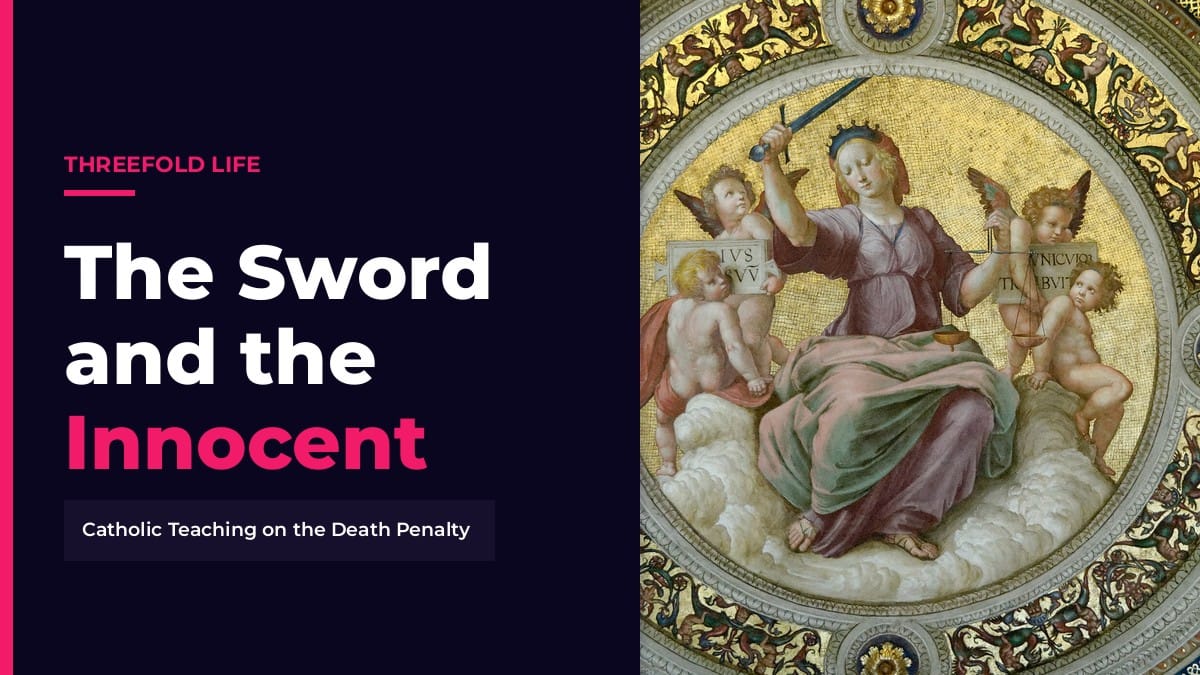
Pope Leo XIV calls the death penalty inadmissible. Scripture, Innocent I, Aquinas and the Catechism of Trent taught otherwise. A case for the sword.
On November 5, 2009, Nidal Hasan, a U.S. Army major and psychiatrist, opened fire at the Soldier Readiness Processing Center at Fort Hood in Texas. He killed 13 people and wounded 32 others while shouting “Allahu Akbar.” Hasan later stated that he wanted to stop U.S. soldiers from deploying to Afghanistan to kill Muslims and described himself as having “switched sides” to protect the Taliban. In 2013, a military jury convicted him of 13 counts of premeditated murder and 32 counts of attempted premeditated murder and sentenced him to death. He is now scheduled to be executed by firing squad on December 3, 2026, at Fort Hood. This will be the first U.S. military execution since 1961 and the first by firing squad since World War II. The Pentagon has announced that the execution will be livestreamed.
It was against the backdrop of this planned public execution that Pope Leo XIV posted on X on October 10, 2026:
“The death penalty is inadmissible because it is an attack on the inviolability and dignity of the person. The common good can be safeguarded and the requirements of justice can be met without recourse to capital punishment: effective systems of detention have been developed that protect citizens while at the same time do not completely deprive those who are guilty of the possibility of redemption. #NoDeathPenalty.”
— Pope Leo XIV (@Pontifex on X, October 10, 2026)
The statement is nearly identical to the language Pope Francis inserted into the Catechism of the Catholic Church in 2018. Pope Leo XIV is not inventing a new position; he is continuing the trajectory of his immediate predecessor. That trajectory, however, stands in sharp contrast to the consistent witness of Scripture, the early papal magisterium, the Doctors of the Catholic Church, and the official catechisms that formed Catholic conscience for centuries.
Today’s Catholic world seems divided into liberal and conservative camps, not unlike Protestants. The importance of traditional Catholics in the ongoing culture war against the destruction of traditional values in the United States and the West as a whole cannot be overstated. The pro-life movement is one of many examples that demonstrate how important it is for the work of the Kingdom of God on earth for us to be allies in saving the West from the satanic grip of leftist ideologies and influences. The current debate around the death penalty, instigated by the sentencing and planned public execution of Nidal Hasan, reveals once again the ongoing division in the Catholic world. Let’s pray for God to prevail and for the lies of the communist-influenced left to be exposed.
Scripture Speaks Clearly
The foundation is not medieval speculation. After the Flood, God Himself declared: “Whoever sheds the blood of man, by man shall his blood be shed, for God made man in his own image” (Genesis 9:6). The image of God is the very reason capital punishment is authorized for murder—not a reason to abolish it.
The apostle Paul affirms the civil sword under the inspiration of the Holy Spirit: “For he is God’s servant for your good. But if you do wrong, be afraid, for he does not bear the sword in vain. For he is the servant of God, an avenger who carries out God’s wrath on the wrongdoer” (Romans 13:4). The New Testament nowhere abolishes this authority. Jesus acknowledged that Pilate’s power to crucify came from above (John 19:11), and the good thief on the cross confessed that he and his companion were receiving the due reward of their deeds (Luke 23:41).
The Death Penalty at the Center of the Redemptive Narrative
The issue of the death penalty is not a peripheral political question. It stands at the very center of the Bible and the redemptive narrative of the New Testament, because Christ Himself was sentenced to death unjustly and executed in public. The cross is the supreme injustice of human judgment and the supreme act of divine justice at the same time.
Nowhere in the New Testament do we see any of the apostles protesting against the death penalty itself. Had the apostles—who possessed firsthand understanding of God’s will—shared the mind of the current pope, they would almost certainly have sent a clear message that they opposed all and any use of the death penalty. They did not. They did not even revolt or publicly protest the unjust sentencing of the Messiah. They understood the redemptive mystery behind Jesus being unjustly condemned to death and executed in such a public fashion. That silence and that understanding should put to rest any lingering questions about the Christian attitude toward the death penalty today.
The Historic Catholic Witness
In 405, Pope St. Innocent I answered the Bishop of Toulouse on precisely this question. Citing Romans 13, he wrote:
“It must be remembered that power was granted by God, and to avenge crime the sword was permitted; he who carries out this vengeance is God’s minister… Why should we condemn a practice that all hold to be permitted by God? We uphold, therefore, what has been observed until now, in order not to alter the discipline and so that we may not appear to act contrary to God’s authority.”
St. Thomas Aquinas, the Common Doctor of the Catholic Church, gave the classic theological defense in the Summa Theologica (II-II, q. 64, a. 2):
“If a man be dangerous and infectious to the community, on account of some sin, it is praiseworthy and advantageous that he be killed in order to safeguard the common good, since ‘a little leaven corrupteth the whole lump’ (1 Cor. 5:6).”
He compared the criminal to a diseased limb that a physician must amputate to save the body.
The Catechism of the Council of Trent (the Roman Catechism, 1566), commissioned by the Council and published under Pope St. Pius V, taught the same under the Fifth Commandment:
“Another kind of lawful slaying belongs to the civil authorities, to whom is entrusted power of life and death, by the legal and judicious exercise of which they punish the guilty and protect the innocent. The just use of this power, far from involving the crime of murder, is an act of paramount obedience to this Commandment which prohibits murder. The end of the Commandment is the preservation and security of human life… Hence these words of David: ‘In the morning I put to death all the wicked of the land…’”
This was the ordinary teaching of the Catholic Church for well over a millennium.
The Modern Turn
Pope John Paul II already narrowed the practical application, arguing in Evangelium Vitae that modern prison systems make cases of absolute necessity “very rare, if not practically non-existent.” Pope Francis went further. In 2018 he revised paragraph 2267 of the Catechism of the Catholic Church to declare the death penalty “inadmissible” in principle as an attack on dignity, and he committed the Catholic Church to work for its worldwide abolition. Pope Leo XIV has now made the same language his own public position.
The shift tracks a broader pattern visible in recent decades: a preference for therapeutic language, an emphasis on the dignity of the offender over the justice owed to victims and the protection of the innocent, and an alignment with progressive Western political priorities that treat capital punishment as inherently barbaric.
Ultimately, the humanistic approach to the death penalty evidenced by the statements of the current pope and the religious leftist establishment reveals the tendency of Western Christianity after World War II to side with false constructs of empathy against the true interpretation of God’s word. True charity and liberty do not consist in abstract affirmations of dignity detached from justice. Charity protects the widow, the orphan, and the ordinary citizen from the predator. Liberty is meaningless if the state refuses the means necessary to restrain those who destroy it.
Faith, Liberty, and Charity
At Threefold we hold that authentic biblical faith renews the mind and orders culture according to God’s truth (Romans 12:2). Liberty is not license; it is the ordered freedom that exists when justice is done and the innocent are secure. Charity is the love that seeks the true good of the neighbor—including the neighbor who may one day be the victim of the criminal the state refuses to restrain.
The historic Catholic tradition understood this. It did not celebrate bloodshed; it recognized that in a fallen world the civil authority, under God, bears the sword for the protection of the common good. The current papal statements represent a significant departure from that tradition. Whether one is Catholic or Protestant, the question remains the same: Do we receive the witness of Scripture and the consistent teaching of the ages, or do we adjust doctrine to the prevailing winds of contemporary liberalism?
The God who made man in His image also authorized the sword for the shedding of blood. That is not a contradiction. It is the serious recognition that human life is so valuable that the deliberate destruction of the innocent must be answered with the most serious of penalties—so that others may live in peace.
Sources
- AP News — Pentagon says execution of Fort Hood shooter will be livestreamed (Oct 2026)
- BBC — Who is Nidal Hasan? What to know about US plans to livestream an execution
- U.S. Army — Fort Hood shooter Hasan sentenced to death (Aug 30, 2013)
- CNN — Fort Hood shooting jury recommends death penalty for Nidal Hasan (Aug 28, 2013)
- Pope Leo XIV (@Pontifex) on X, October 10, 2026
- Vatican News — Pope Leo XIV rejects death penalty as attack on dignity of human person
- Congregation for the Doctrine of the Faith — 2018 rescript revising CCC 2267
- Edward Feser — papal statements on the death penalty (Innocent I, Ep. VI to Exsuperius; PL 20:495)
- St. Thomas Aquinas — Summa Theologica II-II, q. 64, a. 2 (New Advent)
- Catechism of the Council of Trent — Fifth Commandment
- Catholic Answers — The Church and Capital Punishment
- St. John Paul II — Evangelium Vitae (1995), §56
Scripture: Genesis 9:6, Romans 13:4, John 19:11, Luke 23:41, 1 Corinthians 5:6, Romans 12:2.