19 Arab Seats in the Knesset: So Much for "Apartheid"
In Israel's October 27 election, Arab-led parties won a record 19 of the Knesset's 120 seats, after Israel's own Supreme Court made sure they could run. Try finding anything like that anywhere else in the Middle East.
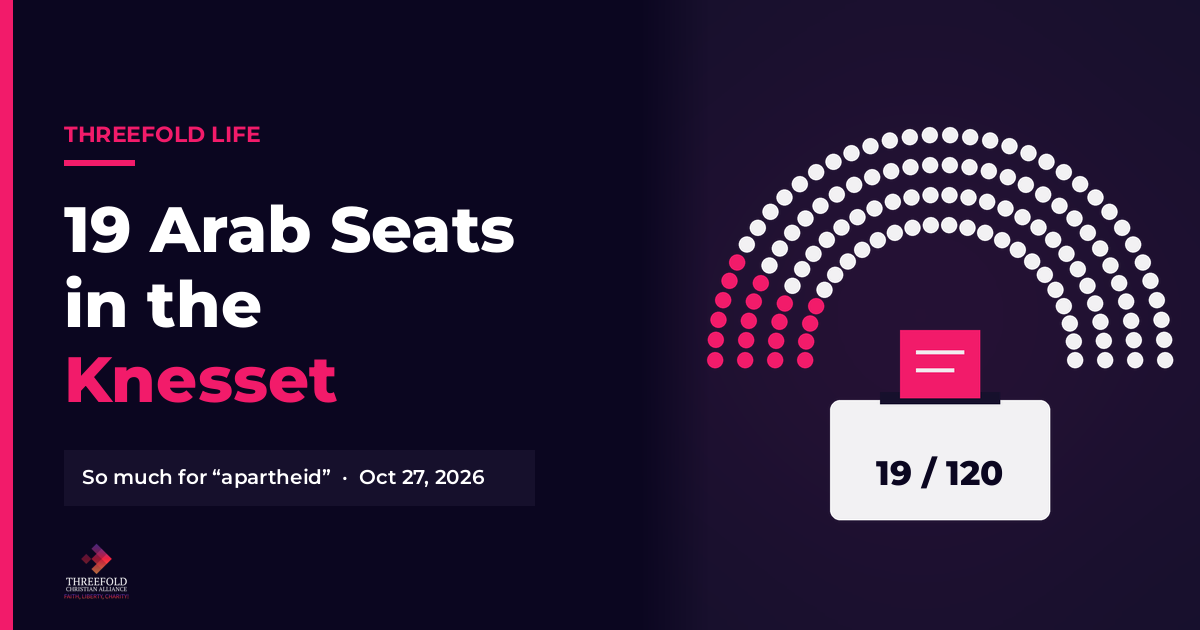
On October 27, Israel held a national election. When the Central Elections Committee finished the count on October 30, two Arab-led parties had won 19 of the Knesset's 120 seats: 11 for the Joint List and 8 for Ra'am. According to the Associated Press, that is the largest number Arab-led parties have ever won, beating the old record of 15.
Hardly anyone in the West is talking about it. They should be, because it doesn't fit the story we keep hearing on campuses, on the streets, and from the pulpits of some churches: that Israel is an "apartheid state" bent on "genocide" against Arabs.
"Their largest-ever number of seats in Israel's parliament"
That line is from the AP, not from an Israeli government press office. AP reported that nearly 840,000 people voted for Ra'am and the Joint List, 64 percent more than in 2022. The Israel Democracy Institute puts turnout in Arab and Druze towns at about 77 percent, up from 53 percent four years ago. In Sakhnin, a Galilee town, turnout was 87 percent, the highest in the whole country.
Look at who won. Ra'am is led by Mansour Abbas, whose party began as what some commentators call “Islamist” (we prefer jihadist), and sat in the Bennett–Lapid governing coalition in 2021. The Joint List is an alliance of three Arab-led parties, Hadash, Ta'al and Balad, headed by law professor Yousef Jabareen, with veteran MK Ahmad Tibi second. Tibi has sat in the Knesset since 1999, and he has been one of the sharpest critics of the Jewish state, from the floor of its own parliament. Nobody has jailed him for it. Israelis argue with him, and then the country carries on.
Many of these voters, by AP's account, turned out to protest the government and the crime in their towns. Good. That is exactly what citizens of a free country do. Under an apartheid regime you are not allowed to vote the government out. Arab Israelis are free to try, and this year more of them tried than ever before. Some “Apartheid“!
Israel's Supreme Court put the Arab parties back on the ballot
There is a second part to the story, and I think it is even more telling. In September, Israel's Central Elections Committee, which is made up largely of party representatives, voted to bar both the Joint List and Ra'am from the election. On October 2, Israel's Supreme Court unanimously overturned those bans. That included the Joint List with Balad on it, a party that has long called for Israel to stop being a Jewish state and become "a state of all its citizens".
The justices didn't hide that they found some candidates' words offensive. The court called the conduct of one Jewish Hadash MK "revolting", then let him run anyway. The court ruled that the right to vote and to be elected is a constitutional right of particularly high standing, and that disqualification is an "extremely drastic measure" to be read narrowly. The court did not simply wave everyone through, either. Balad's chairman withdrew after the justices signalled that a majority would uphold his personal disqualification.
That is the rule of law. The state's highest court protected the right of its fiercest critics to sit in its parliament. Ask yourself which other government in the region would do that. I’ll wait…
Arab citizens have sat in every Knesset since 1949
This year's election is not a one-off. Three Arab members, Tawfik Toubi, Seif el-Din el-Zoubi and Amin-Salim Jarjora, sat in the very first Knesset in 1949, and Arab citizens have been elected to every Knesset since.
They have done more than vote. Salim Joubran, an Arab Christian, was appointed permanently to Israel's Supreme Court in 2004. In 2011 he sat on the three-judge panel that upheld the rape conviction of a former President of Israel, Moshe Katsav. In 2022 Khaled Kabub was sworn in as the Supreme Court's first Muslim justice. In 2007 Raleb Majadele became Israel's first Muslim Arab cabinet minister. In the army, Maj. Gen. Ghassan Alian, a Druze officer who once commanded the Golani Brigade, was appointed head of COGAT, the body that runs Israel's civil liaison with the Palestinians.
Arabs make up about 21.7 percent of Israel's population, roughly one in five, according to the Central Bureau of Statistics. Does a state committing "genocide" swear its victims onto the Supreme Court bench?
856,000 Jews who are no longer there to vote
Now turn the question around. How many Jews sit in the parliaments of the Muslim world?
I want to be careful here, because the honest answer is not "none". Iran's constitution reserves one seat in its parliament for a Jewish member. Turkey had a Jewish MP, Cefi Kamhi, in the 1990s. Tunisia appointed a Jewish tourism minister, René Trabelsi, in 2018.
These are exceptions, and the reason they are exceptions is the real story. According to Israeli government figures cited by the BBC, (not organization known to be friendly to Israel or the Jews), 856,000 Jews fled Arab countries in the four years after Israel was founded in 1948. Over the following decades, ancient communities in Baghdad, Cairo, Aleppo, Tripoli and Sana'a, many of them older than Islam itself, were emptied. You simply cannot elect a Jewish representative when the Jews have been driven out.
As for Iran's one reserved seat, it sits in the parliament of a regime whose Supreme Leader said in 2015 that "there will be nothing left of the Zionist regime in 25 years". A token seat under that kind of government is not equality. It is a museum piece.
Strange enough, many Muslims are the first victims of the very governments I am describing. My quarrel is with the regimes.
The only Middle Eastern country Freedom House rates "Free"
Here is something anyone can check. In Freedom House's Freedom in the World 2026, Israel scores 73 out of 100 and is rated "Free". Every other country in the Middle East and North Africa is rated "Partly Free" or "Not Free": Iran 10, Saudi Arabia 9, Syria 10, Egypt 18.
The Economist Intelligence Unit's Democracy Index 2025 reaches the same conclusion by its own method. Every state in the region is classed as "authoritarian" or a "hybrid regime" except Israel, which it rates a "flawed democracy". I'll take the "flawed" part. Every real democracy is flawed, America included. What none of Israel's neighbours can claim is the second word.
So the map is not hard to read. One country in the region holds free elections, lets its Arab minority win a record share of parliament, and lets its courts protect its loudest opponents. The others are run by kings, jihadi clerics, generals and strongmen. We can see who the tyrants are.
"The stranger that dwelleth with you shall be unto you as one born among you"
Christians should care about this for more than political reasons. Western liberty grew out of a biblical root: that every human being bears the image of God, that rulers are under law, and that the stranger is to be treated justly. "But the stranger that dwelleth with you shall be unto you as one born among you, and thou shalt love him as thyself; for ye were strangers in the land of Egypt: I am the LORD your God" (Leviticus 19:34, KJV).
Israel is not perfect, and its Arab citizens have real grievances. But it is the one country in that region where a minority can carry those grievances to the ballot box and into the Knesset, and where they won 19 seats this year. When you next hear Israel called an apartheid state, remember those 19 seats. Then ask where the Jewish members of the parliaments in Baghdad, Damascus and Riyadh are.
Pray for the peace of Jerusalem, and stand with the one free nation in that troubled region.
Sources
- Bakalpi: Israel Elections 2026, final results (Central Elections Committee data, Oct 30, 2026)
- AP via PBS: "A historic vote born of fear and frustration for Palestinian citizens of Israel" (AP original)
- Israel Democracy Institute: Arab turnout in the 26th Knesset election (Hebrew)
- The Joint List: Representatives
- Jerusalem Post: Supreme Court allows Cassif, Ra'am, Joint List to run (Oct 2, 2026)
- Israel National News: Supreme Court overturns election bans (Oct 2, 2026)
- Israel Democracy Institute: Arab Politics in the 2022 Election Campaign (Balad platform)
- List of Arab members of the Knesset
- Israel.com: Salim Joubran, first permanent Arab Supreme Court justice
- Ynet: Katsav's rape conviction stands (2011)
- Times of Israel: Khaled Kabub sworn in as first Muslim justice
- Reuters: Israel names first Muslim cabinet minister (2007)
- Times of Israel: Druze general named liaison to Palestinians
- Jerusalem Post: CBS population figures ahead of Rosh Hashanah 2026
- Constitution of the Islamic Republic of Iran, Article 64
- European Jewish Parliament: Cefi Jozef Kamhi
- JTA: Jewish businessman named government minister in Tunisia (2018)
- BBC: Jewish refugees from Arab lands
- JTA: Iran's Supreme Leader: Israel will not exist in 25 years (2015)
- Freedom House: Israel, Freedom in the World 2026 and all country scores
- EIU: Democracy Index 2025