A Soldier's Life: Why the Christian Never Musters Out
Bishop J. C. Ryle taught that every Christian is a soldier from conversion to death. Why holiness means warfare, and why grace drives the fight.
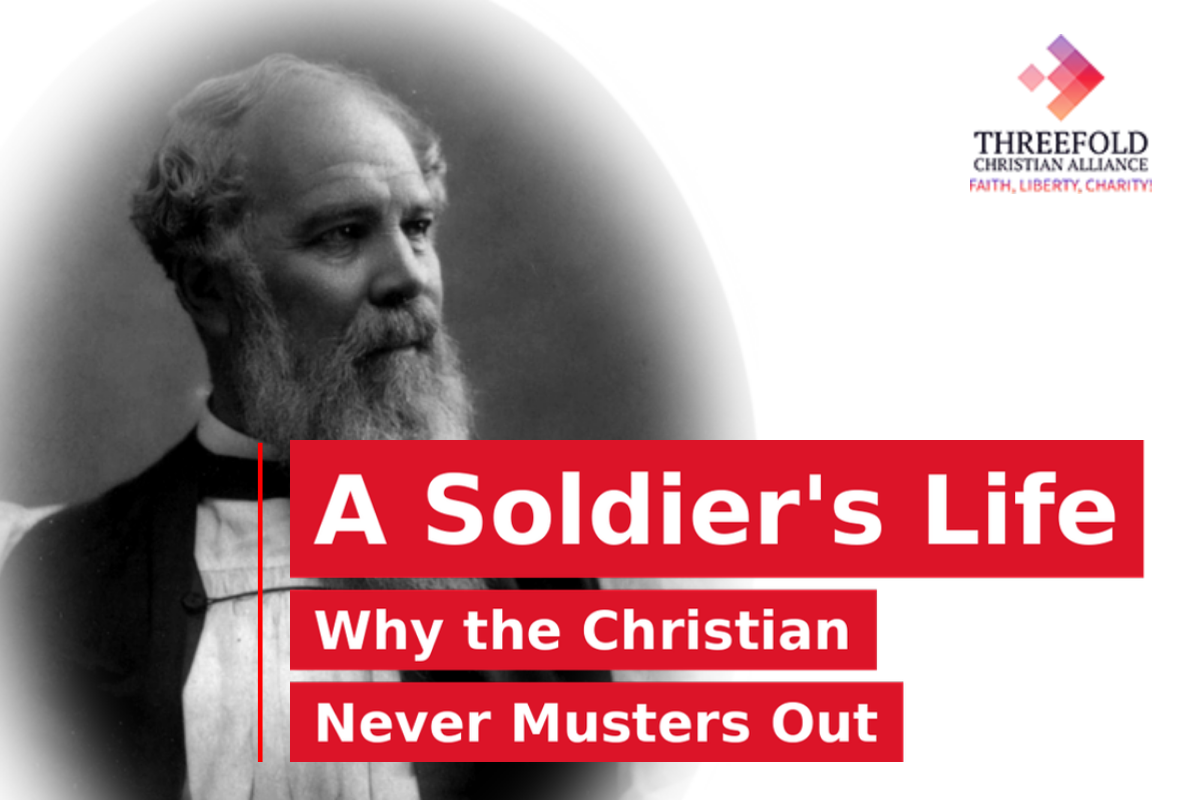
I recently read about the life of British Christian leader and author, John Charles Ryle, a.k.a. J. C. Ryle.
He was born on 10 May 1816 at Macclesfield, the eldest son of a wealthy banker and Member of Parliament, and the path in front of him looked settled.
A chest infection at Oxford turned him to the Bible and to an evangelical conversion he later dated as the moment he passed from death to life. London smog then drove him out of legal study after six months. In June 1841 his father’s bank collapsed. The family rose one morning with the world before them and went to bed ruined. The estate was sold. The political career was over. Years afterward Ryle wrote that if he had not been ruined, he would never have been a clergyman, never have preached a sermon, or written a tract or book.
He buried all three of his wives. His first, Matilda, died in 1847, less than two years after their marriage. His second, Jessie, died in 1860, leaving him with young children. His third, Henrietta, his companion of twenty-seven years, died in 1889. Through those years he became a national voice for plain evangelical religion inside a Church of England increasingly drawn toward ritualism, and he treated that contest as a fight over the gospel itself, not over vestments. In 1880, when Ryle was sixty-four, Disraeli sent him to the new diocese of Liverpool, more than a million people in a raw industrial city. He spent the last twenty years of his life building churches and mission halls there. He retired in 1900 and died that June at Lowestoft. His successor, Bishop F. J. Chavasse, called him "that man of granite with the heart of a child."
The book that drew my attention recently is Holiness. The topic of holiness is perceived as equally controversial, uncomfortable and abstract by many people today. Most modern people seem to fall into two extremes of interpretation. There are those who see talk of holiness as a scam which powerful religious institutions use to keep naive followers under their control. And then there are those who are ready to kill in the name of whatever they consider holy.
It is my conviction that holiness is neither. What we people think of as holy, or sacred, might not be at all what the Creator calls holy.
Enter J. C. Ryle and his take on holiness in his book Holiness.
Holiness is...warfare?
We like our metaphors comfortable. We speak of Christianity as rest, as refuge, as peace. And it is all of those things. But the New Testament keeps reaching for a stranger image to describe the believer: the soldier. Not the tourist. Not the guest. The soldier.
Bishop J. C. Ryle built much of his classic Holiness (1877) on that single word. "He that would understand the nature of true holiness must know that the Christian is 'a man of war,'" he writes. "If we would be holy we must fight."
From conversion to death
Ryle refuses to let us limit the warfare to the dramatic early days of faith. "The true Christian is called to be a soldier, and must behave as such from the day of his conversion to the day of his death," he insists. There is no muster-out. No honorable discharge after the first victory. The very thing that makes us holy — our union with Christ — also enlists us.
Which means the ordinary Tuesday morning, with its small temptations and quiet discouragements, is already a battlefield. You do not have to manufacture a fight. One is already waiting for you.
What the soldier is not
Ryle is blunt about the alternative. The Christian "is not meant to live a life of religious ease, indolence, and security," he warns. "He must never imagine for a moment that he can sleep and doze along the way to heaven, like one traveling in an easy carriage."
That image of the easy carriage lands harder every decade. We have made comfort the measure of blessing, and ease the evidence of God's favor.
Ryle says the opposite: if your faith costs you nothing and disturbs you not at all, you may have taken your standard of Christianity "from the children of this world" rather than from Scripture.
The saddest symptom
Perhaps his sharpest sentence is aimed not at open sinners but at quiet churchgoers. "The saddest symptom about many so-called Christians is the utter absence of anything like conflict and fight in their Christianity," he writes. "They eat, they drink, they dress, they work, they amuse themselves, they get money, they spend money, they go through a scanty round of formal religious services once or twice every week. But of the great spiritual warfare — its watchings and strugglings, its agonies and anxieties, its battles and contests — of all this they appear to know nothing at all."
Struggle, in other words, is not necessarily a sign of weak faith. Its total absence may be the real alarm.
Where the promises are
Ryle does not leave us under a burden. He anchors the fight in grace: "There are no promises in the Lord Jesus Christ's epistles to the seven churches, except to those who 'overcome.' Where there is grace, there will be conflict. The believer is a soldier. There is no holiness without a warfare. Saved souls will always be found to have fought a fight."
Notice the order. Grace produces the fighting; the fighting does not produce the grace. A soldier fights because he has been enlisted by a victorious commander, not in hopes of winning enlistment. Christ has already won the war; we fight in His name, with His armor, from a position of acceptance rather than toward it.
Living as one enlisted
So what does this look like on Monday? Let's go for some honest self-examination. Are there sins you have stopped resisting because resistance grew tiring? Prayer you have let become routine instead of desperate? Scripture you read for information rather than ammunition?
Ryle's aim was never to make believers anxious. It was to make them awake. A sleeping soldier is not safe — he is merely convenient. And the God who recruits does not send His own into battle unarmed or unequipped.
The fight is hard. But as Ryle reminds us, it is also the road on which saved souls are always found.
The full argument is in Holiness: Its Nature, Hindrances, Difficulties, and Roots, first published in 1877 and enlarged in 1879. A scanned 1887 edition is free to read at the Internet Archive: https://archive.org/details/HolinessJ.C.Ryle1887
Sources
All quotations are from J. C. Ryle, Holiness: Its Nature, Hindrances, Difficulties, and Roots, chapter IV, "The Fight" (enlarged edition, London: William Hunt and Company, 1887, Internet Archive scan), pp. 74–96.